
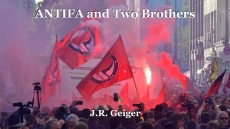
Short Story by: J.R. Geiger
Genre: Historical Fiction
James and Kevin had been best friends since they were toddlers. They were brothers by every definition except blood. Inseparable.
Their fathers had been best friends too—boys who grew up in the same small Iowa town, joined the military together, and somehow, through what James’ mother called “divine choreography,” always ended up stationed together. When one got transferred, the other soon followed. Their families moved in tandem, like two branches of the same tree.
James and Kevin grew up with the same values: love of God, family, country, and their fellow man. They fished together, prayed together, played football and baseball together.
They knew the Pledge of Allegiance by heart before they could spell their own names. By middle school, they could recite the preamble to the Constitution word for word—“We the People of the United States, in Order to form a more perfect Union…”—not because anyone made them, but because they believed in it.
Their fathers taught them to stand when the anthem played, to kneel for the fallen, to help strangers in need, and to speak the truth even when it hurt.
They even roomed together in college—same dorm, same routines, same late-night talks about life and legacy. But something changed sophomore year.
James came back from class one afternoon and found Kevin gone.
No note. No heads-up. Just an empty bed and a stripped desk. Kevin had moved into another dorm with someone James didn’t know.
When James texted, he got no reply. When he called, it went to voicemail. On campus, Kevin avoided him—ducking into buildings, turning away in the dining hall, vanishing into crowds.
It was like watching a brother vanish into smoke.
Then came the text: “Big rally today. Come see what matters.”
James hesitated. But he needed to know. He needed to see for himself.
They met at the edge of the woods behind the university. Kevin was already masked, dressed in black from head to toe. He handed James a hoodie and a bandana. James had come to observe, not to participate, and he had no intention of arming himself.
“Wear it,” Kevin said. “You don’t want your face out there.”
James frowned. “Why not?”
“Cameras. Cops. Consequences.”
They walked deeper into the woods. James noticed pallets tucked behind trees and bushes, covered with tarps. Kevin pulled one back.
“Bricks, rocks, signs,” he said. “And bottles. Some bleach. Some paint.”
James stared at the stash. “Where did all this come from?”
Kevin shrugged. “No idea. We just get a location. It’s different every time. The network gets it here.”
“Why?” James asked.
“To be ready. You don’t want to improvise when the moment hits.”
James felt his stomach tighten. “This isn’t a protest. It’s a war zone.”
Kevin grinned. “Exactly.”
They emerged from the woods and joined the masked crowd heading toward the courthouse. The sun was high, casting sharp shadows across the pavement. James saw the others—uniformed in black, faces covered, carrying signs and shields. The air buzzed with tension. Kevin was electric, eyes gleaming.
“This is ANTIFA,” he said. “We’re the firewall against fascism.”
James nodded, unsure. He’d always believed in standing up to hate. But something felt off.
At the courthouse, the crowd swelled. Across the plaza, a small group of counter-protesters stood with flags and signs. One held a placard that read, “Free Speech Is Not Hate Speech.” Another wore a Vietnam Veteran’s cap and sat in a wheelchair, holding a small American flag.
Kevin growled. “Bootlickers.”
The chants began:
“No justice, no peace!”
“Punch Nazis!”
“Burn it down!”
James watched silently, but the energy shifted. A bottle flew. A flare hissed. Someone screamed.
Masked figures surged forward.
A masked protester punched the wheelchair bound veteran in the face, knocking his hat and small American flag to the ground. He tried to speak, but another protester spray-painted his face and chest as blood streamed from his nose. James watched, frozen, as Kevin tackled a man holding a flag.
“Fascist!” Kevin shouted, fists flying.
The man didn’t fight back. He curled into himself, bleeding.
James stepped forward and pulled Kevin off the man. “Kevin, stop!”
Kevin turned, eyes wild. “He’s the enemy!”
“He was just standing there!”
“He’s a symbol! Symbols burn!”
Then James saw her—an elderly woman with a walker, trying to enter the courthouse. She wore a floral blouse and orthopedic shoes. Her juror badge was pinned to her collar. She moved slowly, deliberately.
A masked figure blocked her path. “No justice, no court!”
She tried to explain. “I’m here to serve. I was summoned.”
They shoved her. She stumbled. James rushed forward, catching her before she fell.
“What are you doing?!” he shouted.
“She’s part of the system!” someone yelled.
“She’s a citizen!” James roared. “She’s doing her duty!”
Police moved in. Sirens wailed. Smoke filled the air. James walked away.
He sat on a bench by a planter near a shattered café window, peeling off the hoodie and the bandana he’d been given. He crumpled them into a ball and tossed them into a nearby trashcan. Inside, a barista sobbed, clutching her arm.
James approached. “Are you okay?”
She nodded, trembling. “They said we were capitalist scum. I just make coffee.”
Her name was Kelly. She’d worked there for three years. Her mother owned the shop.
“They spray-painted ‘Eat the Rich’ on our wall,” she said as she cried. “We’re barely getting by.”
James comforted her and then helped her sweep glass from the floor. The sun streamed through the broken window, illuminating the wreckage.
Later, he walked alone through the woods. The trees were quiet. No slogans. No smoke. Just wind and memory.
Kevin caught up with him near the trailhead, still buzzing.
“Hell of a day,” he said. “We made a statement.”
James didn’t reply.
Kevin leaned in. “You know we’re getting paid for this, right?”
James blinked. “Paid?”
“Yeah. Not much, but enough. Some orgs funnel it through crypto. Others through ‘mutual aid’ or some other bullshit. Keeps the fires burning.”
James stared at him. “So ALL THAT, back there, is what it’s for?”
Kevin shrugged. “It’s a means to an end. It’s a tool.”
James turned away.
That afternoon, he grabbed his camera, sketchpad, and pencil. He walked back downtown. He didn’t draw slogans or fists. He drew faces—unmasked, wounded, real.
He sat on that same bench, sketching—the veteran in the wheelchair, face bloodied, his flag crumpled beside him. The elderly juror, her walker overturned, her dignity bruised. Kelly behind the shattered glass, her teary eyes wide with fear.
He sketched the bookstore owner scrubbing graffiti from his wall. A mother sweeping glass from her bakery. Her child staring at the broken window.
He also documented in pictures the true cost of their “protest”—not in slogans, but in people.
The next day, he walked to the courthouse. The graffiti was still there.
“ACAB”
“Kill Capitalism”
“No Mercy”
He saw a man scrubbing the wall. His name was Ahmed. He owned the bookstore next door.
“They smashed my windows,” he said. “I sell poetry. Not politics.”
James helped him scrub.
That evening, Kevin called. “You ghosting me?”
James paused. “You’re not fighting. You’re just hurting people.”
“We’re fighting fascism!” Kevin’s voice was high and strained.
“You’re just another mob, Kevin. I saw it.” James’s voice was quiet, full of a hollow ache. “You were always the one to help someone shovel their driveway. You used to help and pray for people, not hurt them.”
Kevin laughed, but it was a brittle, sharp sound. “That was a kid’s game. This is real.”
“It’s a lie.”
Silence. James heard a long, shaky exhale on the other end of the line.
“I don’t recognize you anymore,” James said finally. “I look at you, and I don’t see my brother.”
Kevin hung up.
James sat in the quiet. He watched the trees outside his window. He was out of the woods now. But the forest lingered in his bones.
He opened his sketchpad and drew again—not fists or flames, but more faces. Human faces. Unmasked. Vulnerable. Real.
He didn’t know what came next. But he knew what he wouldn’t be part of.
And that was enough.
***
Later that night, as he uploaded his thoughts, pictures, and drawings to his blog and captioned each with the names and stories of those harmed, James reflected on everything he’d seen. The pallets in the woods. The veteran bleeding in the wheelchair. The elderly juror shoved for trying to serve. The barista sobbing behind shattered glass. The bookstore owner scrubbing away slogans he never asked for.
He thought about Kevin—his childhood friend, his brother in everything but blood—now masked, paid, and proud of the destruction.
And it hit him with brutal clarity.
ANTIFA wasn’t anti-fascism. It was the epitome of it.
The intimidation. The suppression. The mob rule. The violence against the innocent. The facelessness.
It wasn’t a movement. It was a masquerade.
And if truth still mattered, then the name should reflect it:
Antagonistic
Needy
Terroristic
Infantile
Faceless
Assholes
© Copyright 2026 J.R. Geiger. All rights reserved.
Regular reviews are a general comments about the work read. Provide comments on plot, character development, description, etc.
In-line reviews allow you to provide in-context comments to what you have read. You can comment on grammar, word usage, plot, characters, etc.

Makes one wish they were born in Scandinavia, Holland or Switzerland — anywhere but in Los Estados Estupidos. I’ve been fed a line of bs for 70 years about how great my country is. But first, we had to deal with the ‘savages’ in the country by ‘asking’ them to ‘move over a little bit.’ It’s a long, sad story, the US. I lived through ‘trickledown’ economics for my entire working life and saw my benefits shrink every year. My retirement is an ‘entitlement’ now. I was forced to leave the country I couldn’t afford to live in anymore. My wife and I are glad we moved to Costa Rica in 2011 — where humanity still thrives.
Well written, btw, showing the divide of the Divided States of America.

Author
Reply
It is sad.
There's no dialog.
The left claims to be inclusive unless you disagree or say something they don't like. Then they try to cancel you and call it hate speech.



whatta