
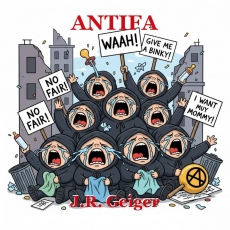
Essay by: J.R. Geiger
Genre: Editorial and Opinion
From my personal observations and research, the debate surrounding the movement known as ANTIFA is far more complex than the simple black-and-white narrative often presented. While I can appreciate the stated goal of opposing fascism and white supremacy, my examination of their tactics and impact has led me to believe that they are, in fact, not only ineffective but also deeply problematic.
One of the most striking things I've observed is the use of violence and property destruction as a central tactic. Proponents might frame this as a necessary form of "self-defense," but the empirical evidence suggests that it is strategically flawed and counterproductive. Research by political scientists like Erica Chenoweth and Maria Stephan has shown that non-violent movements are historically more than twice as likely to succeed as their violent counterparts, and they are also more likely to lead to lasting democratic change. The destruction I've seen at protests only serves to alienate the public and provide opponents with a convenient tool to discredit the entire cause.
Beyond physical confrontations, I have observed that ANTIFA's methods are fundamentally at odds with the concept of open debate and the marketplace of ideas. Instead of engaging in reasoned discussion to counter opposing viewpoints, the movement often seeks to shut down speech entirely through disruption and intimidation. This has been seen in numerous incidents, such as the protests at the University of California, Berkeley, and Middlebury College, where speakers were prevented from giving their talks by masked protesters who used chanting, noise, and even violence to silence them. This approach, rooted in the belief that "fascist" speech is a form of violence that should not be tolerated, rejects the long-standing liberal principle that the best way to defeat bad ideas is to expose them to the light of public scrutiny and argument, not to suppress them.
Furthermore, I have seen firsthand how their methods, such as "deplatforming" and doxing—the public release of private information—raise serious questions about fundamental democratic principles. While the aim may be to silence hate speech, the practice itself can devolve into vigilanteism, bypassing due process and the rule of law. This tactic sets a dangerous precedent, allowing a decentralized group to unilaterally decide who deserves a platform and then enforce that decision through intimidation. The irony is palpable: an anti-fascist movement that seeks to forcibly silence and de-platform those with whom they disagree is, in practice, adopting the very methods of censorship and suppression that are hallmarks of authoritarianism.
A critical point that I have found in my research is that the claim that ANTIFA's targets are proven racists or fascists is often murky. While some of their confrontations, such as those at the 2017 "Unite the Right" rally in Charlottesville, have been against openly white supremacist and neo-Nazi groups, many other targets have been people or organizations that have not been legally or factually proven to hold such beliefs. Often, their accusations of fascism and racism rely on a broad and subjective definition, one that is frequently echoed by left-leaning politicians and the mainstream media without independent verification. This reliance on public accusation rather than verifiable fact is deeply troubling and undermines the credibility of the movement's actions.
The most damning piece of information I have come across in my research is the strong evidence that many protesters are not motivated by ideology alone but are being paid. Segments on the news, for example, highlighted the bizarre phenomenon of a "protest business" that was struggling to hire enough paid protesters, lamenting a labor shortage in the field. This points to a cynical industry of "activists for hire" that can be deployed to create manufactured outrage. The very notion that people are being paid to protest for a movement that claims to be a grassroots rebellion against the established order is, in my view, the ultimate hypocrisy. It strips the movement of its authenticity and reduces it to a staged political spectacle.
Finally, there is the glaring hypocrisy in the relationship between this movement and the very government it so vehemently protests. Many of the individuals I have seen involved in these demonstrations are college students, a demographic that is disproportionately reliant on government financial aid, such as federal grants and student loans, to pay for their education. It strikes me as profoundly ironic that a movement with strong anti-state and anti-capitalist ideologies is, in many cases, sustained by the very system they are trying to dismantle. They hold their hand out for government money for their schooling while simultaneously denouncing the institutions that provide it. It's a contradiction that, to me, undermines the sincerity of their anti-establishment message.
In conclusion, my personal analysis is that while the sentiment behind anti-fascism is laudable, the methods employed by ANTIFA are not. Their tactics of violence, deplatforming, and illiberalism are not only counterproductive to their goals but, in a deeper sense, are a dark reflection of the very thing they claim to fight. A more effective and principled path for social change lies in non-violent resistance, open dialogue, and a commitment to the democratic institutions that protect civil liberties.
Let their name reflect their actions...
Antagonistic
Needy
Terroristic
Infantile
Faceless
Assholes
Bibliography
* Chenoweth, Erica, and Maria J. Stephan. Why Civil Resistance Works: The Strategic Logic of Nonviolent Conflict. Columbia University Press, 2011.
* Shankman, Hannah. "How to Close Pandora’s Dox: A Case for the Federal Regulation of Doxing." Journal of Law & Public Policy, vol. 33, no. 2, 2023.
* StudentAid.gov. "Types of Financial Aid: Grants, Work-Study, and Loans." U.S. Department of Education.
* Crowds on Demand. Crowds on Demand, LLC.
* Bray, Mark. Antifa: The Anti-Fascist Handbook. Melville House, 2017.
* Congress.gov. "Are Antifa Members Domestic Terrorists? Background on Antifa and Federal Classification of Their Actions." Congressional Research Service, 2020.
* Turley, Jonathan. "The Hypocrisy of Antifa." The Hill, August 29, 2017.
* The Center for Strategic and International Studies (CSIS). "Who Are Antifa, and Are They a Threat?" CSIS, June 4, 2020.
* Associated Press. "What is antifa? A look at the movement Trump is blaming for violence at protests." PBS NewsHour, June 1, 2020.
* Babb, Sarah. "What is antifa and who funds it?" Fox Business, June 2, 2020.
* Vysotsky, Stanislav. American Antifa: The Tactics, Culture, and Practice of Militant Antifascism. Routledge, 2020.
* Turley, Jonathan. "The Right to Rage: Free Speech and Rage Rhetoric in American Political Discourse." Georgetown Law, 2023.
* Wong, Julia Carrie. "UC Berkeley cancels 'alt-right' speaker Milo Yiannopoulos as thousands protest." The Guardian, February 1, 2017.
* Fischer, Brian, and Christopher A. W. O'Keefe. "Understanding 21st-Century Militant Anti-Fascism." CREST Research, April 14, 2021.
* Hedges, Chris. "The Left and the Rise of the Right: A Critique of Antifa." ScheerPost, April 18, 2021.
* Swart, Adam. "Crowd company CEO details paying protesters as requests surge under Trump." Fox News Video, August 15, 2025.
* Friedman, Nate. "Nate Friedman Uncovers Who's Paying Protesters." China in Focus on NTD News Video, August 29, 2025.
* Demonstrators March To Keep Ann Coulter From Speaking At UC Berkeley. YouTube Video, February 1, 2017.
* Jones, Seth G., and Catrina Doxsee. "Examining Extremism: Antifa." Center for Strategic and International Studies (CSIS), June 24, 2021.
* Feldstein, Steven. "Rethinking Antifa." The Blue Review, Boise State University, March 12, 2018.
© Copyright 2026 J.R. Geiger. All rights reserved.
Regular reviews are a general comments about the work read. Provide comments on plot, character development, description, etc.
In-line reviews allow you to provide in-context comments to what you have read. You can comment on grammar, word usage, plot, characters, etc.


